
Use less and reuse more
Products that you can reuse again and again can help you to save money in the long run – and they can also help to reduce the overall amount of waste that is created.
A research by DECO PROteste made for IKEA in December 2025 to April 2026 shows that a Portuguese household of three* can save 204€ per year by avoiding disposables and opting for reusable alternatives for shopping bags, water bottles and rechargeable batteries. At the end of one year, you'll have saved 15kg of waste, on shopping bags, water bottles and caps and alkaline batteries.
*Household made up of three people, two adults and one child or young person. Both adults work outside the home and the child or young person goes to school or university
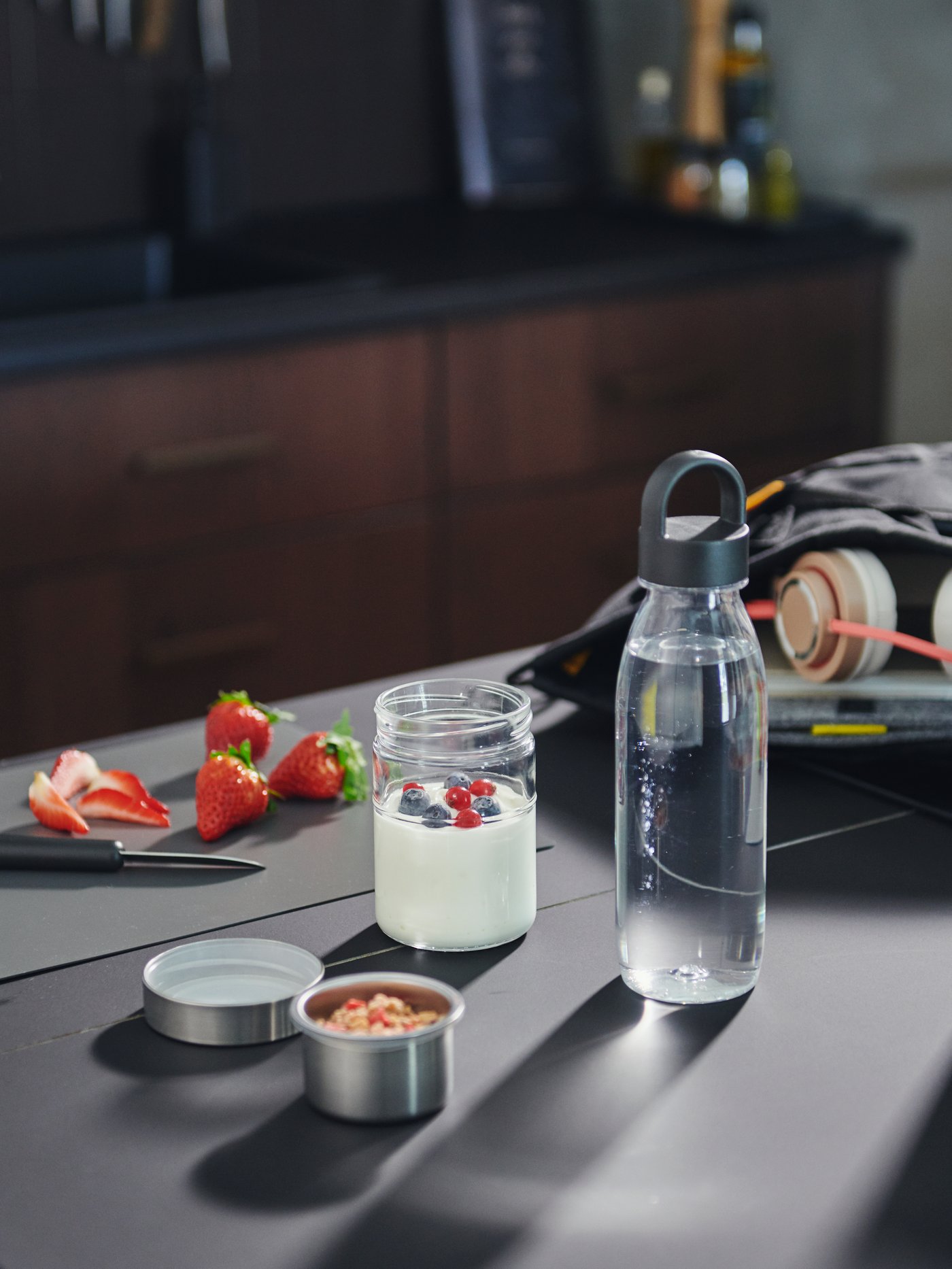
Savings of 178€ per year by using a reusable water bottle
If you stop buying a bottle of water every day and use an IKEA 365+ water bottle instead and fill it up with tap water, you can save 178€/year and significantly reduce the waste generated.
In the Portuguese market, an average cost of 0,50€ per 1.5L bottle was identified. If you work out the amount spent on single-use water bottles at the end of just one week, you'll see it's higher than the price of an IKEA 365+ water bottle. At the end of one year, you'll have saved 10.9kg in waste from bottles and their caps alone.
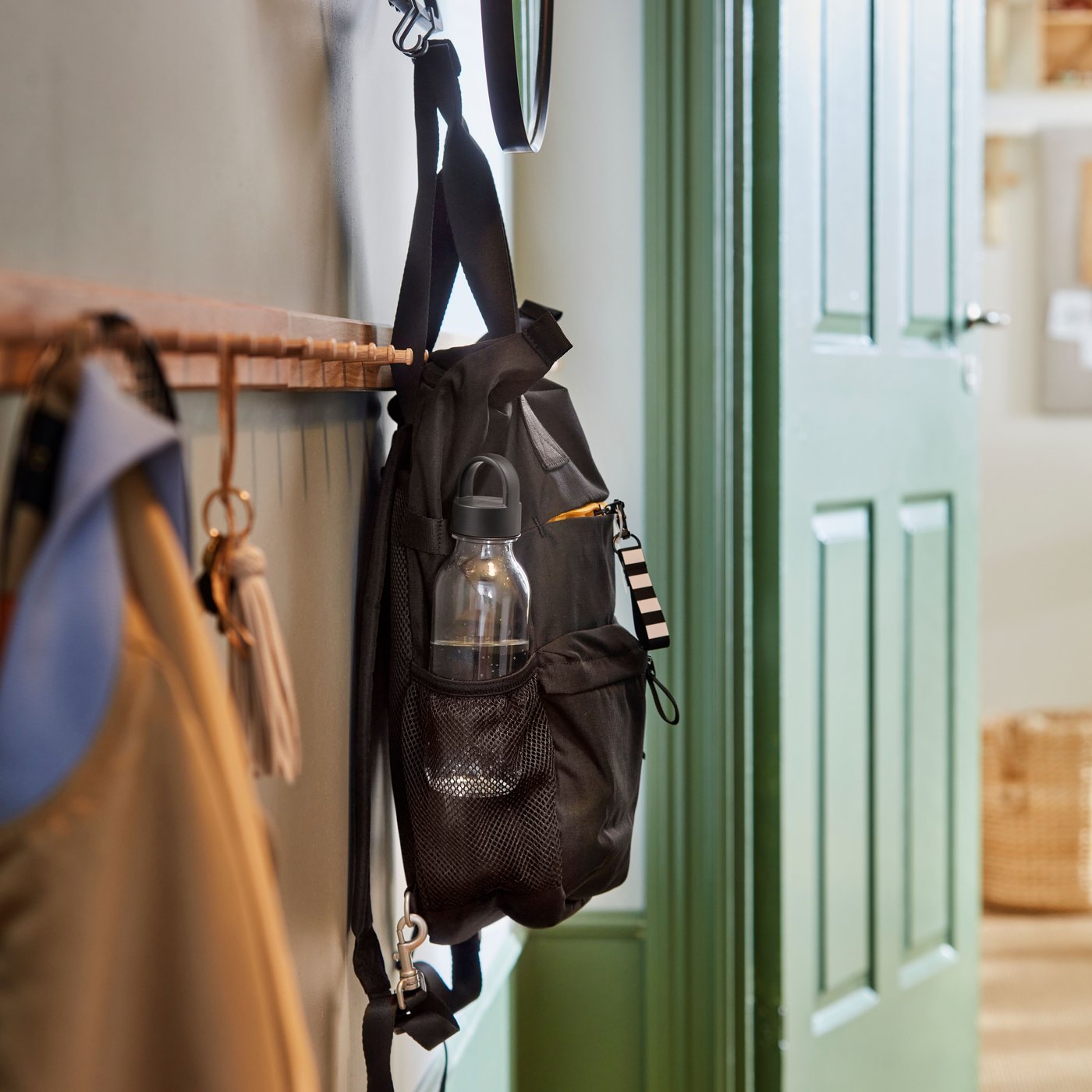
Savings of 178€ per year by using a reusable water bottle
If you stop buying a bottle of water every day and use an IKEA 365+ water bottle instead and fill it up with tap water, you can save 178€/year and significantly reduce the waste generated.
In the Portuguese market, an average cost of 0,50€ per 1.5L bottle was identified. If you work out the amount spent on single-use water bottles at the end of just one week, you'll see it's higher than the price of an IKEA 365+ water bottle. At the end of one year, you'll have saved 10.9kg in waste from bottles and their caps alone.

The plastic in one 1.5L water bottle weighs around 30g; using one water bottle/day generates 10.9kg of waste/year.
Savings of 15€ per year by using reusable bags
By replacing disposable plastic bags when shopping at the supermarket with FRAKTA reusable bags, you can save 15€ per year.
Assuming that the family does a weekly shop that occupies a total volume of 40 litres, corresponding to three disposable plastic bags, these can be replaced by one FRAKTA bag.At the end of one year, you will have avoided more than 3.7kg of waste on plastic bags alone.
In financial terms, the annual cost of buying these disposable bags is 15.6€, which is much more than the price of one FRAKTA bag.
For a two-person household, or a one-person household where all meals are eaten at home, the savings are the same, as the conditions are assumed to be equivalent.

Replacing plastic bags for your supermarket shopping with one FRAKTA bag cuts out more than 3.7kg of waste per year.
Another alternative to a single-use plastic bag is the SKYNKE bag: practical, lightweight and small enough to fit in a pocket
By replacing single-use plastic bags for grocery shopping with reusable SKYNKE bags, you can save 11€ a year.This is based on a family doing a weekly shop that takes up a total of 40 L, equivalent to 3 single-use plastic bags, and replacing them with 3 SKYNKE bags.
Over the course of a year, this would prevent more than 3.7 kg of waste from single-use plastic bags alone. The annual cost of buying these disposable bags is 15.6€, much higher than the cost of buying 3 SKYNKE bags.
These savings from using reusable products are not included in the total savings shown for a family of 3, as this is an alternative scenario.
Savings of 11€ in the first year of using rechargeable batteries
Replacing disposable alkaline batteries with rechargeable LADDA batteries can save 11€ in the first year of use and 28€ in each subsequent year.
This includes the cost of the batteries and the STENKOL charger, with the charger’s cost deducted from the first-year savings. Over 3 years, the total savings amount to 67€.
This is based on using batteries in the TV remote control and computer mice in a family of 3.Each year, this would prevent 330 g of waste from disposable batteries.


Tips and ideas for saving at home



In association with:
