
Minimalism is out: Australians are embracing a new era of ‘curated clutter’, IKEA research reveals
Australians are turning their backs on minimalist living and embracing a new approach to life at home: 'curated clutter'.
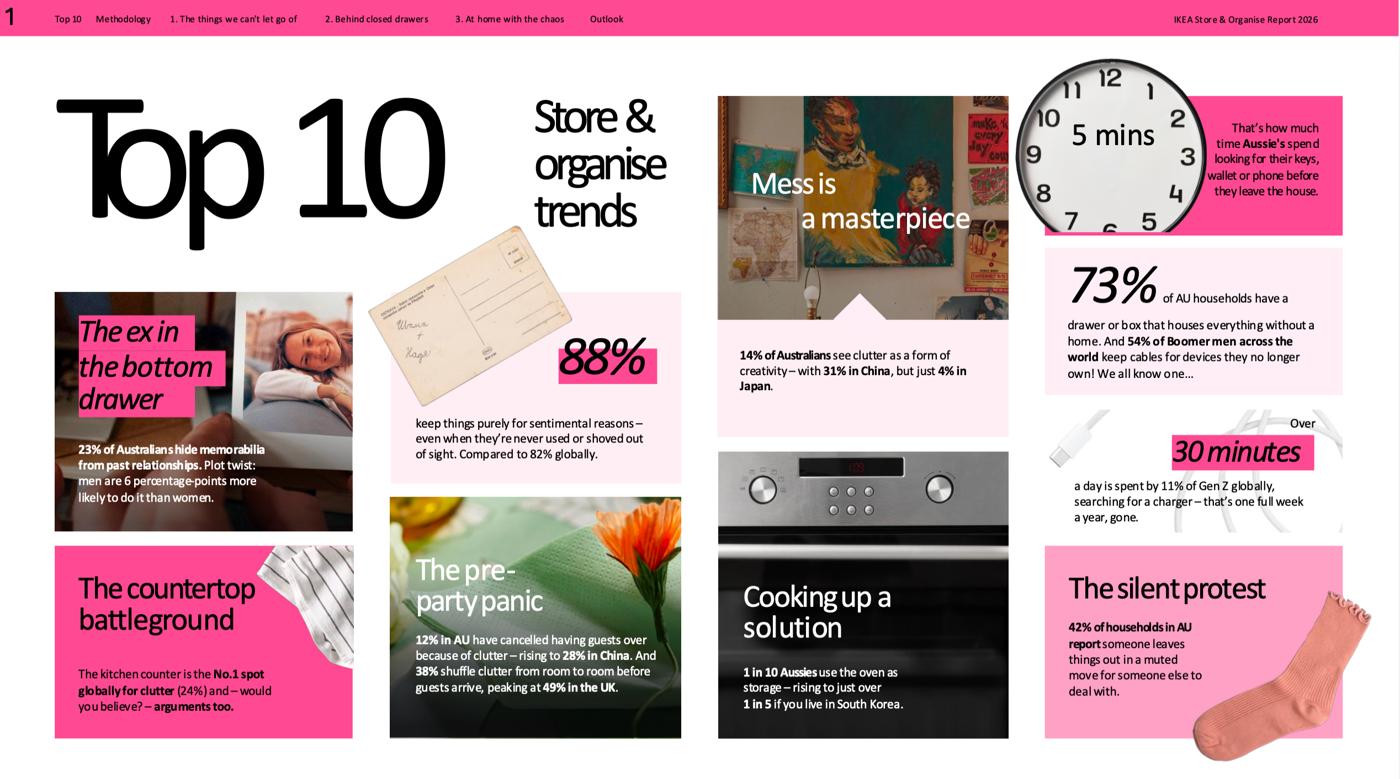
New research from IKEA reveals Aussies are increasingly rejecting perfectly pared-back interiors in favour of homes filled with the belongings, hobbies and memories that matter most. IKEA's latest 2026 Store & Organise Report found almost two-thirds of Australians (62%) prefer a home that's organised but still reflects their personality, while 87% admit they've held onto items purely for sentimental reasons.
Yet as Australians fill their homes with the things they love, they're also grappling with where to put it all. From cluttered kitchen benches and lost keys to silent household stand-offs over mess, the research reveals a growing tension between self-expression and organisation.
The rise of ‘curated clutter’
Forget stark white interiors and owning less. The research suggests Australians are increasingly favouring homes that feel lived-in and reflect who they are, rather than spaces designed around minimalism alone. Just 23% prefer a minimalist aesthetic focused primarily on functionality, while almost two-thirds (62%) favour homes that are organised but still full of personality.
Australians are also highly sentimental, with 87% admitting they’ve held onto items for emotional reasons and 73% confessing to having an “everything drawer” or box filled with items that don’t have a permanent home.
The findings suggest Australians don’t necessarily want less. They want better ways to live with the things they love.
Kitchen bench battles, passive-aggressive piles and misplaced belongings
While Australians may be moving away from minimalism, households are still grappling with the realities of sharing space.
More than one in three Australians (38%) say clutter has sparked arguments with a partner, child or other member of the household, while almost half (49%) say searching for misplaced essentials such as keys, wallets or phones can ruin their day.
The research also uncovered some surprisingly relatable household habits:
- 42% of Australians admit to staging a "silent protest" by deliberately leaving items out in the hope someone else in the household will deal with them.
- More than one in three Australians (38%) say clutter has sparked arguments with a partner, child or other member of the household
- Almost half (49%) say the frustration of searching for misplaced essentials, like keys, wallets or phones, can ruin their day.
- Two-thirds of Aussies (67%) confess to quietly moving other people's belongings back to what they consider their "proper place", without saying a word.
The findings reveal a uniquely modern household tension: Australians want homes filled with the things they love, but not the stress that comes with managing them.
And when it comes to clutter hotspots, one area stands above the rest. More than one-third of Australians (35%) say the kitchen bench is the hardest place in the home to keep organised, significantly higher than the global average (24%). It’s also the space most likely to spark disagreements, with 38% saying kitchen bench clutter has caused tension at home.
The Clutter Divide
While Australians agree homes should feel more personal and less perfect, exactly how that plays out varies significantly across the country.
To better understand the nation’s relationship with clutter, organisation and the possessions people value most, IKEA commissioned additional research into state-by-state attitudes and behaviours.
The findings reveal every state has developed its own approach to life at home:
- Victoria has earned the title of Australia’s clutter capital, with almost one in 10 Victorians (8.5%) describing their home as ‘disorganised’, the highest rate in the country.
- Victorians are also among Australia's most sentimental homemakers, with 71.5% admitting they hold onto sentimental possessions, whether regularly reviewing them or struggling to part with them altogether.
- Tasmanians are Australia's biggest clutter hiders, with more than half (50.7%) admitting they've moved clutter into another room before guests arrive.
- Queenslanders are Australia's biggest keepers of forgotten tech, with 45.3% holding onto cables and chargers for devices they no longer own, the highest rate in the country.
- NSW residents are leading the shift towards personality-filled homes, with 61.9% preferring an organised home that still feels lived-in and reflects who they are.
Together, the findings reveal there is no single Australian approach to organisation. From sentimental Victorians to clutter-concealing Tasmanians and cable-collecting Queenslanders, Australians are finding their own ways to balance the belongings they love with the realities of keeping a home organised.
Ainslie Woodham, Head of Home Furnishing & Retail Design, IKEA Australia & New Zealand, said the findings reflect a shift in how Australians think about the role of their home.
"Our research shows Australians are moving away from the idea that a well-designed home needs to look perfect. Instead, they're embracing 'curated clutter' - making room for the belongings, memories and passions that make a home uniquely theirs."
"What's fascinating is that while Australians want homes that feel organised, they don't necessarily want homes that feel empty. The challenge is creating space for the things you love, while keeping everyday clutter under control, whether that's the pile building up on the kitchen bench or the drawer full of bits and pieces we all seem to have."
“The findings show there is no one-size-fits-all approach. From sentimental Victorians to Queenslanders holding onto old chargers and cables, Australians are finding their own ways to balance organisation with personality."
IKEA invites Aussies to reclaim their space with IKEA Open House
As part of IKEA’s ongoing Store & Organise campaign, IKEA Open House comes to stores nationally from 18–21 September 2026, helping Australians tackle the everyday organisation challenges highlighted in the latest research.
Visitors can explore practical storage and organisation solutions, gain expert advice, discover inspiration for every room of the home and access exclusive offers designed to help create more organised living spaces. Also, for one weekend only, IKEA will transform one of its most recognised storage solutions into a limited-edition collector’s item, available exclusively during IKEA’s Open House weekend. Further details will be revealed soon.
As part of the global campaign, IKEA has also unveiled its smallest-ever pop-up: a handcrafted miniature Melbourne home created by globally renowned artist Christopher Robin Nordström, better known as @TokyoBuild.On display at a Melbourne CBD shopfront, located at 353 Little Collins Street, from 2-20 September, the installation explores how people can make room for the belongings, memories and passions that matter most.
About the IKEA Global Store & Organise Report
The IKEA Store & Organise Report surveyed more than 30,000 adults across 30 countries, including Australia and New Zealand, exploring how people organise, store and live in their homes today.
About the Research
Research conducted by Pureprofile on behalf of IKEA Australia among a nationally representative sample of Australian adults. The survey was commissioned by IKEA Australia to better understand how Australians organise, store and live in their homes, exploring attitudes towards clutter, sentimentality, space and everyday life at home. Findings include national and state-by-state insights into Australians' habits, behaviours and relationship with life at home.
About IKEA:
IKEA offers well-designed, functional and affordable, high-quality home furnishing products, produced with care for people and the environment. There are several companies with different owners, working under the IKEA Brand, all sharing the same vision: to create a better everyday life for the many people. IKEA was founded in Sweden in 1943.
Ingka Group:
With IKEA retail operations in 31 markets, Ingka Group is the largest IKEA retailer and represents about 90% of IKEA retail sales. It is a strategic partner to develop and innovate the IKEA business and help define common IKEA strategies. Ingka Group owns and operates IKEA sales channels under franchise agreements with Inter IKEA Systems B.V. It has three business areas: IKEA Retail, Ingka Investments and Ingka Centres. Read more on ingka.com.